Showing posts with label flyfishing. Show all posts

Monday, 22 October 2018

Something Different - Fly Fishing in Northumberland UK

Another summer vacation and Holly and I head up to Chatton Trout Fishery again for some fly fishing with Bob Smith.  She caught the sole fish on our last and her first visit and experience of trout fishing with a fly rod.  This time it was my turn.  It was a return to the adventure of the book Fishing Trip - An Introduction to Fly Fishing and Trout (Kindle ebook and now as a full colour 5"x 8"glossy paperback at https://www.amazon.co.uk/dp/1729146147    ISBN 9781729146149 for £6.35,  as well as the A4 sized hardback).  However, this was no early morning session.  It was a civilised drive in the late morning for a post-lunch start.

View from the car park
Bob was a little delayed in his arrival at the venue so Holly and I had lunch before doing about 15 minutes unsuccessful fishing before Bob arrived.  We saw a tiger trout swim past our feet a few times while we waited. 

This was the first Rainbow caught
The Fritz patterns I usually start with were not attracting anything.  
Bob arrived and we walked over to the upper lake at its far end where the spring enters into deep water. This was local knowledge coming through.  It had been a low hot dry summer to that point (as evidenced by the parched soil in the photo above), and the fish were deep in the cool fresh spring water.
Bob suggested a small hook wrapped around with copper wire.  Bang!  First cast and as the intermediate line began to sink past a count of 20, the fish hit.
So it continued, the line sinking deep with various pheasant tail nymphs, wire nymphs and olive nymph lures all sinking close to the reeds where the spring fed in.  All in all I had about 7 on and allowed them to come off the hook prior to landing to speed the catch and release process, (and avoid getting the hire car smelling of fish from my hands).
Holly had one on and lost it with Bob's help but he had a floating line and the leader wasn't really long enough to get down to the depth of the feeding fish.
We had a good session and all too quickly had to get back to home and farewell to a lovely spot where NO English (Environment Agency) rod licence (available online or at local post offices) is required as its part of the River Till catchment area feeding into the Tweed.

Friday, 24 April 2015

Sind Halfbeaks get active

Things have been quiet in the water by the beach since October with the surface predators such as Needle fish and Sind Halfbeaks disappearing until a couple of weeks ago with the onset of warmer water and hotter air temperatures.
The take.
I have been wading out the last two Fridays and had one half beak on the 17th and lost one, plus today 24th  landed 2 (largest 14" and smaller 10").  There were many lunges and takes but given the smooth, hard beak its tough to get the hook to lock in.
Played out
Given the activity, I was pretty much kept busy for the 1.5hrs I was in the water on the "little dip" low tide, the full low coming at about 10pm tonight.  Its quite windy today and I timed the visit to coincide with the lowest winds of the day (12-14km/h).
About to be unhooked and released
At time of fishing; humidity was 51%, Wind S & 10km/h, with 1008 millibar pressure

Thursday, 23 October 2014

New Moon at Mangaf

Low tide. Nearly a full spring tide.
Weather:  High of 30oC low of 19oC, Sunny, Wind 8kph from SSW.  Sea calm.
New Moon (0%).  Oct 24 2014.
Sun rise 0554 Sunset 1709
Moon rise 0609 Moon set 1736
Fishing prediction from "Fishing Times Lite v1.2" app for iPhone was "Good".
Low tide 0540 (0.6m)  High tide 1210 (2.3m)  Low tide 1730 (1.1m)  High tide 2340 (2.7m).
MLWN 1.5m  MHWN 2.2m  MLWS 0.6m MHWS 2.7m.  Full Spring tide due 25th Oct.
Tidal data  for Mina Al Ahmadi : 29o04.0'N 048o10'E from "Tide Planner v4.3" app for iPhone.

Views at low tide after last week's rough seas.
1. Looking North

2. Underwater obstacles

3. Looking East to Fahaheel Sea Club marina entrance 


4. Rocky outcrops


5. Underwater obstacles

6. Rocky outcrops


7. Old Coast Guard vessel

From 6 a.m. to 7 a.m. the water was quite busy with needle fish and half beaks chasing the boobies, though not actually greeting the hook points attached on their bony mouths / "beaks". Switching to a white sparkly fly in this water of 1m depth, I then tempted this short-fin goatfish on to the line.
Short-Fin Goatfish (Upeneus oligospilus Lachner, 1954), 
with a 10g lead weight for comparison

Not having caught one of these before, I went to www.fishbase.us to find out what it was, from the Kuwait list of fish species. It turned out to be easy to ID with its bright yellow barbels.

Saturday, 31 May 2014

Getting too hot.

Today its 45C. I've been out a couple of times today. The breeze is strong and like a hairdryer set on hot. The only saving grace is that the forecast dust hasn't materialised.
There is therefore no way I'm going to stand outside and fly fish today, or in any temperature over 40C unless my legs are in glacial meltwater.  That situation should never arise on this planet unless climate change really goes awry.
Sensible fish will be in deep cool water and nowhere near the hot shore.  All that I have to look forward for the next weeks are rising temperatures until I hop on the 'plane to England and real dreary, cool, wet weather. Bliss!

Friday, 16 May 2014

Physics and Fly Fishing.

Objects moving in a fluid generate friction between the fluid and the object’s surface.  This viscous drag can be calculated using Stoke’s Law for a spherical object.
F = 6ph r v
Where F is the viscous drag measured in newtons (N), h (eta) is the viscosity of the fluid in newton seconds per metre squared (Nsm-2), r is the radius of the object in metres (m), and v is the velocity of the object in metres per second (ms-1).

This all got me thinking.  Temperature affects the viscosity of water.  In the winter the water will be more viscous than the hot summer months, especially in a shallow lowland lake or pond.  Flies will sink faster and be dragged through the water faster.  Now I understand that Stoke’s Law is for spherical objects and would only really apply to an “egg” fly but he principle will be still applicable to the other shaped flies as well as the fish, which will also be able to move through water at a faster speed in the summer months.

In salt water, the effect will be heightened, especially in tropical saltwater flats where in the summer months the salinity will increase further.  Do we adjust our fly fishing retrieve speed and counting for sinking to depth for the temperature?  Even within the water column the temperature will vary with depth. In the winter and summer there are temperature zones as their densities vary.  In the spring and autumn the mixing occurs in the water column and the zones disappear as everything gets stirred up.

I am aware that in NE England floating flies attached to sinking lies are prohibited and other flies have lead and brass (gold) head beads etc. added to allow rapid sinking.  That would imply that flies available are either floating or sinking.  With a floating fly and a floating line everything seems simple enough.  When adding in a sinking line you can buy slow sinking, medium sinking or fast sinking casting lines.  That is to say, they are all negatively buoyant.  In winter and summer however, they will be in different temperature water and therefore different density water so with sink at different rates.  Your fly will sink because it has a metal hook and may have lead or copper wire added or a metal head bead. 

Why are all hooks (that I’ve ever seen) made of metal?  Why not ceramic, or hard, clear plastic?  Does anyone make a neutrally buoyant fly that stays at the depth the sinking line drops to and goes no further?  With a floating line it could hover just below the surface.  With a sinking one it would not drop straight to the bottom and could be working its way down slowly with the line.  I don’t suppose for one minute that a dead insect or fish hurtles through the water to the bottom. They drift down slowly.

Is it about time the manufacturers redesigned the hook and fly for its position in the water column?

Tuesday, 15 October 2013

Shores of Mangaf - Kuwait

This is the first site I have looked at for fly fishing in Kuwait.  Access to the beach is via a alley cut through at N29 05.670 E48 08.254 near a lay-by for taxis/buses. The Sea Club is on the right of the picture (south end of the beach).  I took the picture at low tide to discover underwater obstacles that would disappear as the tide came in.  The picture was taken from a concrete platform in front of the building shown below.
The building has now been demolished and currently (Oct 2014) is the pile of twisted metal and rubble shown below.

The platform affords casting possibilities into the rising waters either side of the bollard above the word "Sea" in the first image, depending on the wind direction.  The sand on the beach itself south of the platform is quite steep above the water line, so casting directly out from the water's edge becomes problematic.
When I did try fishing from the platform the first cast  produced this Sind Half-Beak which was returned to the water.
This was caught on an orange floating fry with a flying treble.  Another Half-Beak was hooked later on in the afternoon as high tide was due at 5pm.  Sunset was to follow fairly closely and as I watched the beach from a nearby apartment as night fell, I noticed divers with tridents and lights entering the water to spear larger fish.  This may explain the paucity of the fishing during the day.  A couple of small Houndfish did launch attacks on the flies, so maybe there is hope yet of something larger.
Today (7-10-14) I caught this Sind halfbeak near the large hulk (Hamek) of an old ferry opposite the demolished building beside the Sea Club premises.
The fly was a red booby with its white polystyrene eyes. 

On Friday 3-10-14 off the beach between these points, I caught a small queen fish on a white streamer fly. 


Saltwater Flies and Lures

The images on this post show the selection of flies and lures I have used in the Arabian Gulf.
They have each performed with varying degrees of success, though by far the most successful in terms of numbers of fish, are the orange trout poppers followed by the white floating fry (of which I have none of the originals left).  The white fry shown tried to combine the qualities of the red and white poppers and fry and worked well until the flying treble was lost along with most of the tail to a toothy critter.  In the pictures, the more successful a fly has been, the less legs it has remaining attached.  The attachment of a flying treble also seems to improve the rate of hook-ups and this I attribute to the hardness of many of the fish species' mouth areas.
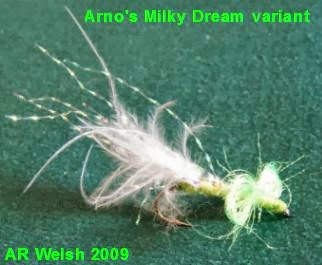
I have used bit detectors to construct my own popper variants as often it is difficult to get the appropriate materials in UAE, Qatar or Kuwait.  Fore example, I was unable to get olive wool for the Arno's Milky Dream fly so used some chartreuse material and white marabou and, at the time, had no internet access, so had to go off a verbal description of the fly scribbled on a piece of hotel note paper.
Some trout poppers ended up being so chewed up they disintegrated.  The one mentioned in the picture is the last of the three originally purchased.
Some of the flies are sea trout trebles and salmon doubles which are too heavy to cast from the shore or while wading with my 9'  rod with 8 wt line, and so are used  trailing from a boat, or flicked into deep water from a pier and allowed to sink and drift before being retrieved.

Monday, 14 October 2013

UAE flyfishing - Abu Dhabi Emirate

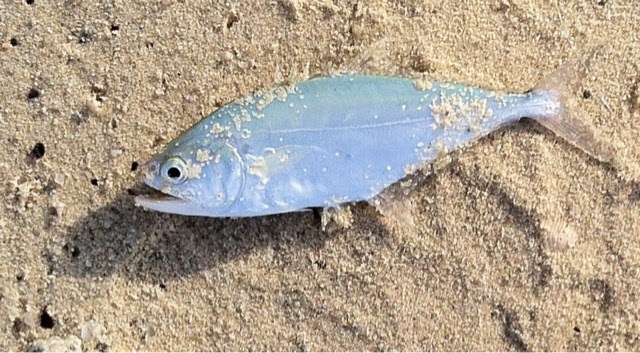
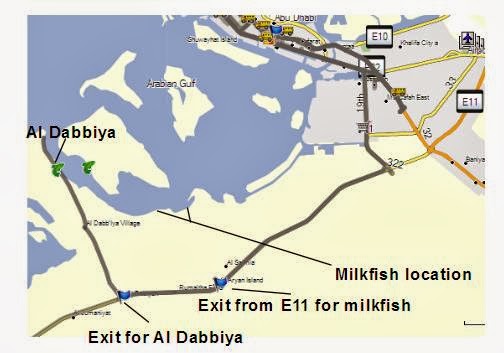
I did find out some useful information when staying at the Crowne Plaza Hotel in Abu Dhabi from the concierge.  A fishing licence was require from the environment agency (100 dirhams) which was obtained easily.  Secondly, Milkfish could be caught using Arno's Milky Dream fly at a location south of Abu Dhabi island.
Mark trying his luck at Al Dabbiya
I researched the fly and made up a couple before setting off to find the spot.  As myself and Mark (the car owner) approached the area signs and fencing warned off further attempts to access it near to N24 14.594 E54 17.525 area.  I can only assume those willing to access cared nothing for the consequences of being caught or we were given spurious directions so we couldn't catch the fish.
 
Anyway, we returned to the main Qatar Abu Dhabi road, and headed to Al Dabbiya.  Again, apart fro access to the water between buildings in the village, all other parts were fenced off and patrolled by the national oil company and police.
Mark went spinning and I tried the fly and again caught more needlefish.  The water's edge in the village was rocky and full of obstacles.  The Milkfish remained like the fly's name - a dream.  However, it's not one that's forgotten yet.  They are in the Gulf somewhere.

Read about the Milkfish and Arno Matthee at this link - http://www.fieldsportsmagazine.com/Saltwater-Fishing/milkfish-mayhem.html

Sunday, 13 October 2013

Al Gharriya, NE Qatar

Al Gharriya, NE Qatar.
N26 04.366 E51 21.544
Again,  this beach had easy access from the road and was 90 km north of Doha.  The journey takes about an hour but the main road goes to 2 way and is quite bumpy towards the end.  I managed to take my eye off the road for a brief moment and lost a wheel to a hole in the road.  That said, the beach is an extension of the sand on the land and plenty of wading is possible.

On the whole from 2004 -2009 when in Qatar, I observed that boat fishing is done by those with boats or who can afford to hire one.  The majority of the labourers who fish seem to use a fixed spool reel from a harbour or other raised point such as a pier.  Others in the last year I was there took to buying a 25 or 50m net with a depth of 1m floats on the top, walk out and mop up large  areas of anything that wouldn't fit through the holes.  That was the end of the "happy time" for fishing in Simaisima for me.  That final year saw me catch only 1 fish (a 5cm long needlefish) there after October 2008.  Prior to that I had averaged 10-20 fish per Friday morning session (7am-1130am).

What there was also at Al Gharriya was a large population of stingrays, which would glide pass my feet as I waded and fished the upper water column.  There area is usually very quiet, apart from a the noise of quad bikes from a resort 1km away when holidays occur.  The fish present for fly sport are half-beaks and needlefish in the main.

Simaisima, Qatar

This is a sunrise on the Arabian Gulf - The Khaleej - at Simaisima in Qatar.
N25 34.708 E51 29.302
Here there are sandy mud flats that stretch far from the shore near to the most northerly mangroves in the Gulf.  The area is eminently wade-able, with easy access from the beach or fishing boat pier.  It is about 20mins by car from Doha.
This was where I first decided to start fly fishing in tropical waters, having previously only done fly fishing in the freshwater rivers and lakes of the UK.  I had being doing conventional sea fishing with fixed spool reel from the piers and multiplier reel from boats in Qatar.  I had worked on a successful technique of  dragging a popping float through the surface with a trailing set of white flies with a 10g weight as I became fed up with cuttlefish stealing the bait from the hooks.  Prawns were becoming more expensive too so a technique without bait as just what I needed.
Needlefish, rainbow runners/Queenfish, sea bass, and others were all jumping onto my trolled flies. It was then that I realised if I could ditch all of the boxes of equipment and weights I was carrying, put on some dive boots, I could wander away from the crowed piers (where personal space was being ignored by the fishermen from less developed parts of the world) and into the sea itself.
That summer during my annual vacation back to England I purchased an Orvis 6-piece travel rod, saltwater reel and line plus a selection of trout poppers (that weren't legal for use in the lakes of NE England, but on sale in the tackle shops beside them) that looked like they would have enough colour and bouyancy to cope with the bright light of the Khaleej.

A fluorescent orange popper with orange and black stripe rubber legs caught this needlefish on the 2nd cast at Simaisima in September 2006.  From then on I spent Friday mornings wading in the sandy shallow waters up the top of my thighs following the tide up the gently shelving beaches.  I found that if I stayed at that depth of water I would be casting into the packs of predatory fish chasing the fry on shore.
Apart from the two-banded needlefish (houndfish), there were Sind half-beaks, yellow hind, banded grunters, fasker and other sea bass that found a fluorescent orange popper or a white floating fry imitation irresistible.
On some occasions I would venture (carefully) towards the trench cut into the limestone bedrock to allow deeper draught boats into the pier at Simaisima. It is a deep cut so I kept about 5m from the edge and did catch some large fish out of the hole.  However, there were other creatures in there such as turtles and large barracuda and sharks.  On several occasions I did lose the body or the whole fish to an attack during playing a fish to a dark torpedo appearing from within the trench.
The longest fish hooked on the fly in Qatar were the 1m long needlefish known as "Long Toms" which are a little unnerving when in the water playing them.   I generally tried to back towards the shore or pier to finish off landing them as their beaks are too sharp to have near your face!
A flying treble is handy on a lure here, as the mouths of some of the fish are very hard and bony and a single hook (especially a barbless one) is unlikely to find or maintain purchase.