Tuesday, 15 October 2013

Shores of Mangaf - Kuwait

This is the first site I have looked at for fly fishing in Kuwait.  Access to the beach is via a alley cut through at N29 05.670 E48 08.254 near a lay-by for taxis/buses. The Sea Club is on the right of the picture (south end of the beach).  I took the picture at low tide to discover underwater obstacles that would disappear as the tide came in.  The picture was taken from a concrete platform in front of the building shown below.
The building has now been demolished and currently (Oct 2014) is the pile of twisted metal and rubble shown below.

The platform affords casting possibilities into the rising waters either side of the bollard above the word "Sea" in the first image, depending on the wind direction.  The sand on the beach itself south of the platform is quite steep above the water line, so casting directly out from the water's edge becomes problematic.
When I did try fishing from the platform the first cast  produced this Sind Half-Beak which was returned to the water.
This was caught on an orange floating fry with a flying treble.  Another Half-Beak was hooked later on in the afternoon as high tide was due at 5pm.  Sunset was to follow fairly closely and as I watched the beach from a nearby apartment as night fell, I noticed divers with tridents and lights entering the water to spear larger fish.  This may explain the paucity of the fishing during the day.  A couple of small Houndfish did launch attacks on the flies, so maybe there is hope yet of something larger.
Today (7-10-14) I caught this Sind halfbeak near the large hulk (Hamek) of an old ferry opposite the demolished building beside the Sea Club premises.
The fly was a red booby with its white polystyrene eyes. 

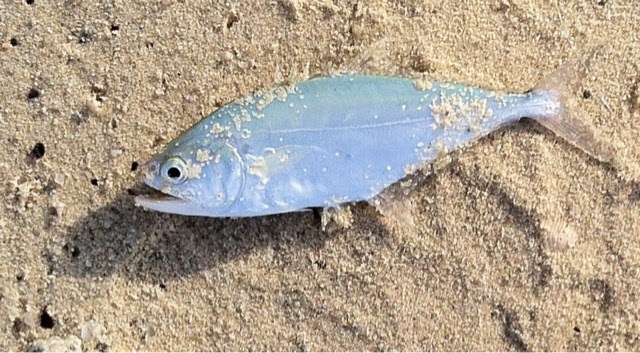
On Friday 3-10-14 off the beach between these points, I caught a small queen fish on a white streamer fly. 


Saltwater Flies and Lures

The images on this post show the selection of flies and lures I have used in the Arabian Gulf.
They have each performed with varying degrees of success, though by far the most successful in terms of numbers of fish, are the orange trout poppers followed by the white floating fry (of which I have none of the originals left).  The white fry shown tried to combine the qualities of the red and white poppers and fry and worked well until the flying treble was lost along with most of the tail to a toothy critter.  In the pictures, the more successful a fly has been, the less legs it has remaining attached.  The attachment of a flying treble also seems to improve the rate of hook-ups and this I attribute to the hardness of many of the fish species' mouth areas.
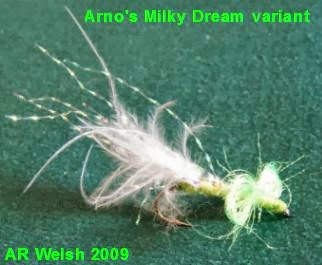
I have used bit detectors to construct my own popper variants as often it is difficult to get the appropriate materials in UAE, Qatar or Kuwait.  Fore example, I was unable to get olive wool for the Arno's Milky Dream fly so used some chartreuse material and white marabou and, at the time, had no internet access, so had to go off a verbal description of the fly scribbled on a piece of hotel note paper.
Some trout poppers ended up being so chewed up they disintegrated.  The one mentioned in the picture is the last of the three originally purchased.
Some of the flies are sea trout trebles and salmon doubles which are too heavy to cast from the shore or while wading with my 9'  rod with 8 wt line, and so are used  trailing from a boat, or flicked into deep water from a pier and allowed to sink and drift before being retrieved.

Monday, 14 October 2013

UAE flyfishing - Abu Dhabi Emirate

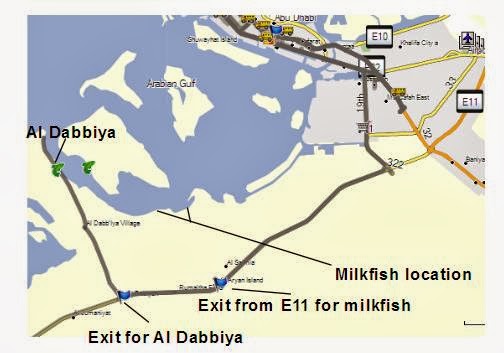
I did find out some useful information when staying at the Crowne Plaza Hotel in Abu Dhabi from the concierge.  A fishing licence was require from the environment agency (100 dirhams) which was obtained easily.  Secondly, Milkfish could be caught using Arno's Milky Dream fly at a location south of Abu Dhabi island.
Mark trying his luck at Al Dabbiya
I researched the fly and made up a couple before setting off to find the spot.  As myself and Mark (the car owner) approached the area signs and fencing warned off further attempts to access it near to N24 14.594 E54 17.525 area.  I can only assume those willing to access cared nothing for the consequences of being caught or we were given spurious directions so we couldn't catch the fish.
 
Anyway, we returned to the main Qatar Abu Dhabi road, and headed to Al Dabbiya.  Again, apart fro access to the water between buildings in the village, all other parts were fenced off and patrolled by the national oil company and police.
Mark went spinning and I tried the fly and again caught more needlefish.  The water's edge in the village was rocky and full of obstacles.  The Milkfish remained like the fly's name - a dream.  However, it's not one that's forgotten yet.  They are in the Gulf somewhere.

Read about the Milkfish and Arno Matthee at this link - http://www.fieldsportsmagazine.com/Saltwater-Fishing/milkfish-mayhem.html

Sunday, 13 October 2013

Al Gharriya, NE Qatar

Al Gharriya, NE Qatar.
N26 04.366 E51 21.544
Again,  this beach had easy access from the road and was 90 km north of Doha.  The journey takes about an hour but the main road goes to 2 way and is quite bumpy towards the end.  I managed to take my eye off the road for a brief moment and lost a wheel to a hole in the road.  That said, the beach is an extension of the sand on the land and plenty of wading is possible.

On the whole from 2004 -2009 when in Qatar, I observed that boat fishing is done by those with boats or who can afford to hire one.  The majority of the labourers who fish seem to use a fixed spool reel from a harbour or other raised point such as a pier.  Others in the last year I was there took to buying a 25 or 50m net with a depth of 1m floats on the top, walk out and mop up large  areas of anything that wouldn't fit through the holes.  That was the end of the "happy time" for fishing in Simaisima for me.  That final year saw me catch only 1 fish (a 5cm long needlefish) there after October 2008.  Prior to that I had averaged 10-20 fish per Friday morning session (7am-1130am).

What there was also at Al Gharriya was a large population of stingrays, which would glide pass my feet as I waded and fished the upper water column.  There area is usually very quiet, apart from a the noise of quad bikes from a resort 1km away when holidays occur.  The fish present for fly sport are half-beaks and needlefish in the main.